


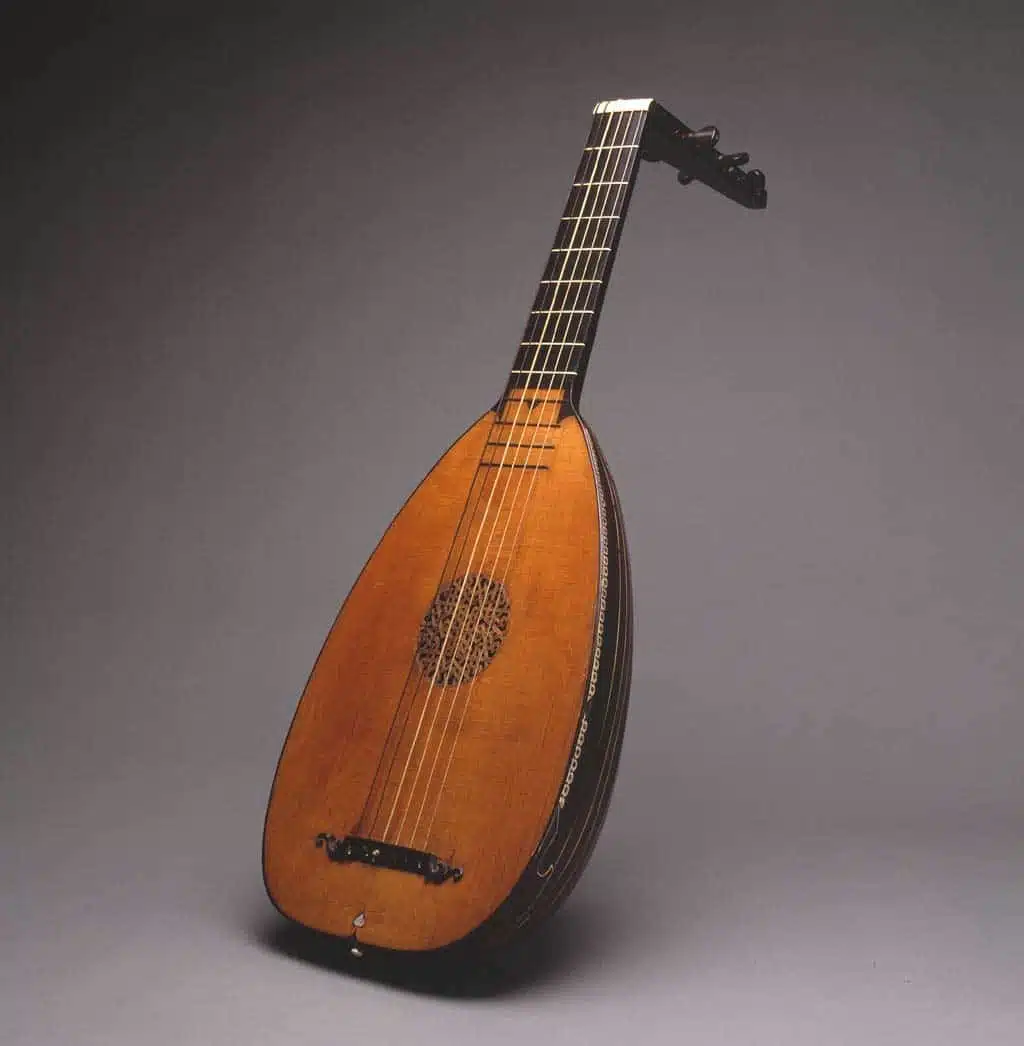
One of the most famous and appreciated European stringed instruments throughout history is certainly the Lute. Its spread across the world is particularly notable, and its extensive use during the Renaissance period made it an excellent medium for creating unforgettable melodies. In the following lines, we will analyze its origins, features, and the best ways to play it.
Table of Contents
What is the Lute
The lute is a plucked string instrument, originally from Asia Minor and widespread in Europe during the Middle Ages. It was one of the most popular instruments in Europe during the Renaissance and Baroque periods, and is still played today in various forms of early and modern music.
The lute has a mandolin-like shape, with an elongated soundbox and a slender neck; furthermore, it has a variable number of strings, usually from 6 to 10 courses, and is played with the fingers or a plectrum. It is a highly versatile instrument that can be used both to accompany the voice and to play musical pieces independently. The lute is often associated with medieval and Renaissance music, but it is also utilized in several other forms of music, such as jazz, folk, and rock. Additionally, there are different variations of the lute, such as the Spanish lute, the Baroque lute, and the Persian lute, each with distinctive characteristics and playing styles.
The term “lute” derives from the Latin “luteus“, which means “yellow”. This term was used to indicate the stringed instrument that had a yellow-colored soundbox, like some of the early lutes that spread throughout Europe during the Middle Ages.
Moreover, the term “lute” might also derive from the Greek “lauthis“, meaning “siren”, referring to the melodious and seductive sound this instrument produces. In any case, the term “lute” has become synonymous with this stringed instrument and is used in various languages to identify it.
How it is made
A lute is composed of several elements, each of which contributes to its shape and sound. Here is a list of some of the main parts of a lute.
Soundbox (Body): this is the part of the instrument that produces the sound; it is usually elongated and elliptical in shape, and is built using different types of wood, such as cedar or spruce.
Neck: this is the part of the instrument that extends from the soundbox and hosts the strings. Usually, the neck is thin and light, constructed with hard woods like mahogany or rosewood.
Strings: these are the parts of the instrument that produce the sound when they are plucked or struck; they are typically made of steel, but in some cases, they can be made of other materials, such as brass or silver (historically gut).
Fretboard: this is the part located on the surface of the neck that allows the playing of different notes. Usually, the fretboard consists of frets made of bone or plastic (historically tied gut), and each of them corresponds to a different string.
Bridge: located at the opposite end of the neck, it holds the strings in tension; it usually consists of a thin, light piece of wood, and is attached directly to the soundboard.
Rosette: this is a circular decoration found on the front of the soundbox, above the bridge, and is usually engraved or carved with decorative motifs, contributing to the instrument’s aesthetics.
Back (Bowl): this is the lower part of the soundbox, located behind the soundboard. It is built from multiple thin ribs of hardwood like mahogany or rosewood, forming a vaulted shape.
Tuning Pegs (Tensioners): this is a mechanism that allows the tuning of the strings, meaning the tension with which they are pulled. They are usually housed in a pegbox angled back from the neck and are used to achieve the desired pitch.
The history and origins of the lute
The lute is an ancient musical instrument, whose origins are lost in the mists of time. The first historical trace of an element similar to the lute dates back to 2500 B.C. in Mesopotamia, where drawings of stringed tools identical to those we know today have been found.
Later, the instrument spread to Egypt, Greece, and Rome, where it became very popular both as a solo element and as an accompaniment for the voice. In the Middle Ages, the lute was one of the most popular instruments in Europe and was used both to play music for the common people and to accompany religious singing.
With the advent of the Renaissance, the lute underwent a major transformation, becoming a larger and more sophisticated instrument, with a greater number of strings and a more elongated shape. Furthermore, during this period, different lute schools developed, each with its own style and specific playing technique.
During the Baroque era, the lute became even more important; it was used both to play solo music and to accompany other instruments. However, with the advent of the piano and the early keyboard instruments, the lute began to lose popularity, eventually becoming an instrument primarily used in folk settings or for early music. Today, the lute is still played in various forms of music, both ancient and modern, and has maintained its beauty and versatility.
Types of lute
There are several types of lutes, each featuring distinctive characteristics and playing styles; here are some of the most common.
Spanish lute: a variation of the lute that developed in Spain during the Renaissance; it has a more rounded shape and a number of strings ranging between 6 and 10. It is a highly versatile instrument, suitable both for playing solo music and for accompanying the voice.
Baroque lute: an alternative of the lute that developed during the Baroque period, particularly in Germany and Italy; it has a more elongated shape and a number of strings ranging between 8 and 12 courses. It is a highly refined instrument, often used to play high-level solo music.
Persian lute (Oud): a form of lute that developed in Persia during the Middle Ages; it has a more rounded structure and a number of strings ranging between 6 and 12. It is a highly expressive instrument, often used to play traditional Persian music.
Classical lute: one of the lute specimens that developed during the Renaissance and Baroque periods, spreading throughout Europe; it has a more elongated shape and a number of strings ranging between 6 and 10. It is very versatile, often used both to play solo music and to accompany other instruments.
Modern lute: a version of the lute that developed during the 20th century, spreading mainly in America; it has a more rounded shape and a number of strings ranging between 6 and 12. It is a very versatile instrument, often used in different forms of music, such as jazz, folk, and rock.
How it is played
The lute is a plucked string instrument, which is played with the fingers or with a plectrum. To play the lute, it is necessary to know some basic techniques, such as plucking and strumming.
Plucking (pizzicato) involves pressing the strings with the fingers of the hands, causing them to vibrate and produce sound. To execute this, it is necessary to use the fingers of the right hand, positioning them in a way to achieve the desired tone.
Strumming (battuto) involves striking the strings with a plectrum, making them vibrate and produce sound. To execute a strum, one must use the plectrum, holding it between the fingers of the right hand and striking the strings with a quick, precise movement.
In addition to plucking and strumming, the lute also involves other performance techniques, such as the tremolo, the legato, and the trill, which are used to enrich the instrument’s sound and to perform musical pieces of greater complexity.
To learn how to play the lute, it is advisable to take lessons with a qualified teacher or utilize educational resources like music books or video tutorials: with a bit of practice and dedication, it will be possible to learn how to play it and perform musical pieces of varying difficulty levels.
Composers who have used the lute
The lute has been used by many composers from different eras and musical styles; here are some of the most famous who incorporated it into their music.
Pete Townshend (1945-): Townshend is the guitarist and leader of The Who, and has used the lute as a solo instrument in many of his compositions, such as “Won’t Get Fooled Again” and “Who Are You”.
Antonio Vivaldi (1678-1741): Vivaldi is one of the most important composers of the Baroque era; he wrote numerous works for the lute, including the “Concerto for lute, strings and continuo” and the “Concerto for lute and strings”.
Jean-Philippe Rameau (1683-1764): Rameau is one of the most important composers of the French Baroque; he wrote numerous works for the lute, including the “Concerto for lute in D major” and the “Suite for lute in E major”.
George Frideric Handel (1685-1759): Handel is one of the most important composers of the English Baroque, and he created several works with this musical instrument, including the “Concerto for lute in D major” and the “Suite for lute in G major”.
Isaac Albéniz (1860-1909): Albéniz is one of the most important composers of Spanish music; he composed numerous works featuring the lute, including “Recuerdos de viaje” and the “Suite española”.
Johann Sebastian Bach (1685-1750): Bach is one of the greatest composers of all time; the works composed for the lute are truly numerous, but among the most important are the “Canticle of the Sun” and the “Sonata for violin and harpsichord” (often arranged for lute).