


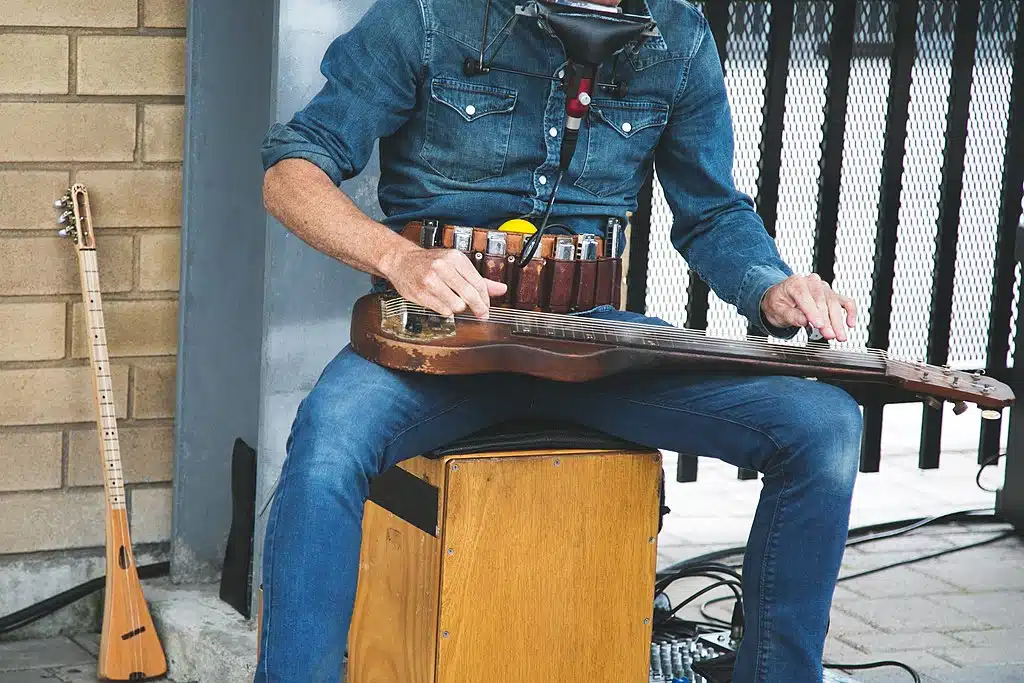
Although its history is linked to various cultures, the Hawaiian lap steel guitar is a stringed instrument commonly used in traditional Hawaiian music.
The lap steel is a handcrafted product and its shape resembles that of a classical guitar, but with a longer neck and an angled bridge. It is a fascinating instrument that tells a story rich in tradition, of relaxing and peaceful music. It has a sound similar to an acoustic guitar but is more intense.
Table of Contents
A brief history of the Hawaiian lap steel guitar
The Hawaiian lap steel guitar, also known as the “Hawaiian guitar” or simply “lap steel“, is an artisanal instrument that has defined the music of the Pacific Ocean for decades.
Its roots date back to the 19th century, when local Polynesian cultures encountered European colonial ones, giving rise to a mixture of influences that created the musical tradition known today as Hula.
Its first iteration dates back to 1832, when a British sailor named Joseph Kekuku, while in the Hawaiian islands, accidentally discovered that by sliding a piece of metal along the strings of his acoustic guitar, new and interesting sounds could be obtained. Since then, the Hawaiian lap steel guitar has become an icon of Hawaiian culture and a symbol of traditional Hawaiian music.
The first true lap steel was created in Maui in the 19th century by Julius Huddy, who built a guitar with a mango wood neck, silver inlays, and a spruce soundboard.
In the 1930s and 40s, thanks to the growing influence of Hawaiian music on American culture, this guitar became a highly popular instrument in the United States.
Many American artists, such as Sol Hoopii and Andy Iona, began using it in their music, thereby introducing the instrument to a much wider audience. This instrument thus became one of the main symbols associated with Hawaiian music.
Throughout the 20th century, new types of strings and tunings were introduced, and modifications were also made to the very structure of the instrument. These changes allowed for a more powerful and versatile sound, enabling the Hawaiian lap steel guitar to become popular in many musical genres: from jazz, to country, to Tejano, to rock’n’roll. Even today, the lap steel is one of the most beloved instruments among guitar enthusiasts all over the world.
Characteristics of the Hawaiian lap steel guitar
It is an ideal instrument for both beginners and experienced musicians. One can choose from various materials, including wood, plastic, and metal, depending on the brand and the type of sound one is accustomed to. In terms of construction, Hawaiian lap steel guitars range from budget models to more expensive ones.
Budget models are often made of plastic, whereas the more expensive ones may feature wooden fretboards with hand-carved engravings. Some models include control knobs, a volume swell, and even a built-in mixer.
Another feature of the Hawaiian guitar is the volume control effect, which is used to produce a variable and wavy sound.
Generally, it is an instrument played while the artist is seated in front of the fretboard.
The body and shape
The body consists of a soundbox with an oval or rectangular shape, typically crafted from solid wood such as mahogany or maple. The body shape is similar to that of a classical guitar, but with the strings positioned horizontally rather than vertically.
The finish can vary, but vibrant colors and decorative motifs inspired by Hawaiian culture are often used.
Perhaps due to its cylindrical shape or the color of the oil paint, the Hawaiian guitar is an instrument that has always attracted attention.
The strings
The strings are placed horizontally relative to the body, rather than vertically (as in most guitars). The lap steel is normally equipped with six steel strings, but some models can have eight or twelve.
They are played with a pick or a plectrum, utilizing a slide technique to obtain different notes. The length of the strings varies depending on the model and the brand, but they are generally longer compared to the strings of a classical guitar.
The strings of this guitar are positioned over a raised grid, known as the lap steel tone bar.
The tone bar
The tone bar is fundamental in producing more complex sounds, including combinations of notes that are not always possible with a standard acoustic guitar.
Regarding the sound, it can have various tones that blend classic sounds with the distorted tones of the blues. It will depend on the artist’s skill to use the lap steel tone bar to adjust the frequency of the notes.
Some advanced models also feature powerful pickups and preamps to make the emitted sound louder.
The neck and the bridge
The neck of the Hawaiian lap steel guitar is often made of solid wood, such as mahogany or rosewood, and has a “U” or “V” shape.
The bridge, usually made of metal, adjusts the height and intonation of the strings. Some models feature a sliding tuning system to easily change the tuning.
Other features
This type of guitar is generally played with a pick, although there are those who use their fingers directly. Conversely, it is played with two picks simultaneously when aiming to achieve a harmonica-like effect.
The left hand is used to adjust the tension of the strings, while the right hand manipulates a volume control to produce a fading effect.
It is played with a technique called “slanting“: the player sits near the instrument, assuming a slightly off-axis position from the waist. This setup allows the player to explore the instrument’s wide tonal spectrum thanks to the precision of their fingers. Furthermore, the sliding motion of the instrument allows one to manipulate the pitch in a fun way.
As with most stringed instruments, the most common techniques used to play the Hawaiian lap steel guitar are arpeggios and chords. However, the use of a diversified pickup palette allows for a wider range of expressive sounds and can be used to achieve sweet, legato slides, forming complex, airy textures. Based on the player’s preference, one can also extend the use of effects (such as tremolo, vibrato, delay, and reverb).
Ultimately, the Hawaiian lap steel guitar is a surprisingly versatile instrument.
Genres and players of the Hawaiian lap steel guitar
To accompany different musical genres such as country, rock, blues, jazz, and rhythm and blues, one simply needs to change the key.
The first and most notable players of this instrument were Leon McAuliffe, still considered one of the greatest guitarists of all time in the western swing and country genres, and Jerry Byrd, a guitarist who used the Hawaiian lap steel guitar in all his compositions with great mastery and skill.
Hawaiian lap steel guitar: how it is played
The basics of the technique
To begin, it is important to learn the correct position of the hands and fingers. The right hand is positioned over the bridge to play the chords, while the left hand must stay over the fretboard to play the single notes.
The chords
Once the basics of the technique are understood, it is important to learn the basic chords; the most common are C, D, E, F, G, A, and B, but there are many other chords that can be learned as one progresses in technique.
The melody
Once you are able to play the basic chords, you can begin to develop the melody. There are different styles, such as fingerpicking and flatpicking, which can be explored to find what best suits your own playing style. It is important to practice constantly and listen to a lot of music to develop your own unique style.
If one learns to play it, its sound is one of the most relaxing produced by any musical instrument.